Loving our Neighbours across the 49th Parallel: Conversation with Friends across our Common Border

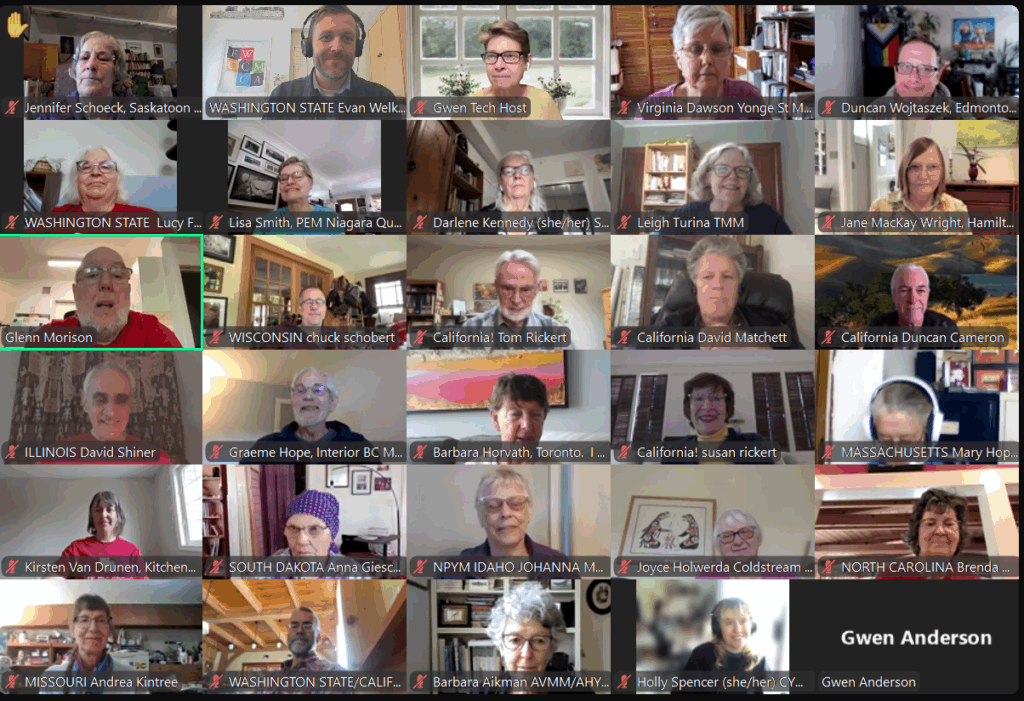
As a part of Canadian Yearly Meeting sessions, Glenn Morison of Winnipeg Monthly Meeting and Co-Clerk of the Representative Engagement Program Group of the Friends World Committee for Consultation, Section of the Americas, organized an online Special Interest Group on June 13, 2025 called:

Loving our Neighbours across the 49th Parallel: Conversation with Friends across our Common Border

After a Welcome from Glenn and an explanation of the gathering by Glenn, Evan Welkin, FWCC Americas Executive Secretary (North Pacific Yearly Meeting), offered a reflection on the work of FWCC to build bridges and cross cultures among Friends, including through the initiative of World Quaker Day which takes place the 1st Sunday of October every year. This year, October 5, 2025, World Quaker Day’s theme is on Galatians 5:14: “Love your neighbour as yourself” There are resources to host WQD events in your meeting here and a further reflection from FWCC General Secretary Tim Gee on the theme here in this month’s issue of Friends Journal.

Glenn Morison then shared a bit more about his motivation for hosting this event as a frequent traveler to and from the United States from Canada, and how the current political situation has deeply affected him. He referenced an experience at the recent FWCC Section of the Americas meeting in which he felt called to minister about the relationship between the US and Canada and an Executive Committee member from FWCC said a delegation might come to Canadian Yearly Meeting to speak to this concern. 

Chuck Schobert, a Friend from Madison, Wisconsin and member of the FWCC Americas Executive Committee, spoke about his experience of making apologies as a US citizen travelling abroad, and offered his apologies to those gathered during the gathering. He spoke of the need to resist unjust policies and also of reaching out directly to offer a different message.

After some Introduction of queries for consideration in our breakout rooms, Friends divided into mixed groups with US and Canadians to consider: 

  • What is your name, where do you live and what is your special interest in being here?
  • Given the reality that Canada – USA relations are the worst they have been since the Pig War of 1859, what is on your heart? What are your fears and hopes? How does this impact you at your deepest levels? 
  • On both sides of the border there have been people who have reported that the current climate has impacted the usual relations between Friends who tend towards a quietest approach and those who lean towards a more activist expression in their life and meeting. Is your meeting impacted by the current political climate? If so, in which ways? And how can we uphold one another in such a situation?  
  • Considering the strained relations between Canada and the USA, what are your thoughts, fears, and hopes? Kazu Haga, a practitioner of Kingian Nonviolence and restorative justice, reminds us that “human beings are not the problem. It is the actions we take, shaped by our life experiences, which are influenced by our culture and larger systems beyond our control. We need to fight the structures and mechanisms that perpetuate harm. To change them, we must understand individual stories and the systems influencing them.” How can we listen to our neighbours’ stories and understand the systems that affect them? 
  • bell hooks, a feminist teacher and theorist, states, “beloved community is formed not by eradicating differences, but by affirming them, by each of us claiming the identities and cultural legacies that shape who we are and how we live in the world.” How can we work towards creating a beloved community in our daily lives? 

We closed the gathering with some brief reflections on the experience and an overall sense of thanks for the opportunity to have the conversation. 

Hubs for the FWCC World Plenary Meeting 2024

The 2024 World Plenary Meeting (WPM) will take place on site in South Africa and online. (See more general information about the WPM and register here) Some Friends will join the WPM online as individuals, and others in groups. We are describing groups of people joining the WPM (and the locations they are joining from) as hubs. Everyone who plans to attend your hub should be encouraged to register so they have access to advance materials here: Registration

A hub is any group of Friends joining the World Plenary Meeting online from another location, from a single internet connection. The group size could be from 3 to 300+, but in many cases will be about 10 or 20 people. They may participate in the complete WPM from August 5-12, 2024 or just in some sessions. You can register to become a hub here

What is needed to be a hub?

Firstly, a hub needs more than two people wanting to join the World Plenary Meeting from another place or country. On registration, we will ask for at least one person to be named as a facilitator/elder for the hub, and a second to be the tech lead. There will be a ‘tech rehearsal’ for tech leads prior to the World Plenary Meeting, and regular check-ins to see how it is going.For larger groups of people, we recommend that a hub has access to:

  • a projector, large screen or monitor
  • a laptop, or tablet
  • a reliable internet, WiFi or data connection
  • a reliable supply of electricity
  • speakers
  • a web camera
  • a microphone

A group of up to about five people could gather around a computer or tablet. They could use the computer screen, microphone, camera and speaker. For the best experience of the WPM, a larger group would need a larger screen, external speakers and an external microphone.

How can I receive support as a Hub?

Limited technical support, for example on connectivity issues, will be provided to hubs through by the World Plenary Meeting Tech Working Group. The contact information for support persons will be provided after your registration as a hub is approved.

  • If you require interpretation for you event, be aware that the World Plenary Meeting official languages include Spanish and Swahili. If you need interpretation in another language, we do recommend finding a local person able to attend your hub and participate in simultaneous interpretation during the event

Planning Online Annual Sessions: Ideas and Resources

Advice from those who have been there!

Kat Griffith and Becky Marty, co-clerks of Northern Yearly Meeting shared this reflection, Toward a Friendly Zoom Liturgy. Thinking somewhat liturgically about our sessions brings out some of the rhythm, richness and depth of our time together. Here are some elements that we included (and a couple that in hindsight we should have). Note that our comments focus mainly on business sessions, but that opportunities abound to build in “liturgy” in other aspects of an annual session.

David Coletta of New England Yearly Meeting created and shared Best Practices for Large Online Quaker Meetings for Business, outlining some of what NEYM’s annual sessions tech team learned about how to prepare and organize the clerks’ team, the supporting tech team, and the participants for their business sessions.

Southeastern Yearly Meeting has created a Virtual Gathering FAQs page with a wealth of information about the online gathering they held in April, including information about program priorities, logistics, training their volunteers and attenders in the use of Zoom, how they organized their sessions, and more. Check it out!

FWCC’s Planning Online Annual Sessions: Sharing Experiences and Ideas

FWCC’s Planning Online Annual Sessions: Moving our Quaker Spaces Online

FWCC’s Planning Online Annual Sessions: Clerking Business Sessions Online

Logistics and Technical Aspects:

Clearly, this depends on what you are trying to do. Here are a few useful starting spots:

Online Clerking Resources:

Pastoral Care in the time of COVID-19

Most Quaker books of discipline, sometimes known as Faith and Practice, have practical and spiritual advices for dealing with death and bereavement. Your yearly meeting may already have a committee of Friends exploring how to be of service in this time. Do seek out local support resources as well.

Even professionally trained pastors may be overwhelmed at this time, by their congregation or their own expectations. Friends have a long tradition of sharing the gifts and call to ministry more broadly. These resources may be useful to you. If you have other suggestions, please send them to Robin Mohr at robinm at fwccamericas.org. We are updating this as we receive links and news. 

Trainings/Workshops/Discussions:

Scott Wagoner, Pastoral Minister at Deep River Friends, is offering a weekly Zoom call every Wednesday from 11AM to 12 Noon EDT (plus an additional session on Friday April 3). In partnership with FUM’s North American Ministries, he is offering this space for programmed and unprogrammed Quakers to talk about how to do pastoral care / presence in this environment, what resources are working, what are we learning, and how we each of us doing. He trained with the Shalem Institute for Spiritual Formation. Contact him at scottwagoner62@gmail.com  to get on the invitation list.

Resources:

Friends General Conference has posted a conversation with three Quaker chaplains on grief, death, and dying and this list of resources on Quakers and Mental Health.

Last year, New England Yearly Meeting published expanded sections of Faith and Practice on death and bereavement with related logistical suggestions.

New England Yearly Meeting has established a page with pastoral care and support resources

Philadelphia Yearly Meeting shared multiple useful resources:

Friends United Meeting posted the following self-care suggestions from Alexander Kern, Director of Northeastern University’s Center for Spirituality, Dialogue, and Service, and New England Yearly Meeting.

Everence, a Mennonite financial services company, can offer professional counseling on debt and budget issuesPhiladelphia Yearly Meeting shares this pastoral care newsletter focused on supporting Friends who are burdened by debt. Though written some time ago, it remains highly relevant.

The US Center for Disease Control published some resources for coping in daily life and particularly for helping to reduce the stigma associated with the coronavirus.

Is there a hospice program near you? They may have additional resources online or local to you. Here is some advice about choosing a hospice provider.

Carl Magruder, board-certified chaplain from Pacific Yearly Meeting sent the following links and advice:

Preparing to go to the hospital: Folks sick with COVID-19 will first be at home, and if they worsen, at some point a decision will be made to take them to hospital.  (Note: Many are leaving this too late, so be in communication with your healthcare provider.)

– Bring a phone, tablet, or laptop to hospital with charger

– Fill out/find/revise/copy your advance care directive and take it to the hospital

– Request a consult with the palliative care team.

Many people have had the experience of making a “baby bag” for a quick trip to obstetrics when a baby is expected.  A hospital bag should be packed and ready to go—toothbrush, pajamas, slippers, sudoku, teddy bear, favorite baseball team cap, etc.  Fun aside, an essential item for the bag is a copy of your advance healthcare directive.  

Some items you will want with you in your bag may be in daily use, and for them, a list should be attached to the bag so that they can be thrown in quickly at a time when folks may not be thinking clearly.  That list should include PHONE/TABLET/LAPTOP AND CHARGER. That way, the patient, possibly with help from hospital personnel, will be able to stay in touch with family from quarantine. (And watch Netflix on hospital wi-fi!)  This is also the case for anyone who goes to hospital with stroke, heart attack, etc. in this time, because they will also not be able to receive visitors. In fact, it’s a good practice any time hospital admission is anticipated.

To me, as a palliative care and hospice chaplain, the inability to be at bedside with loved ones who are approaching or at end of life is one of the hardest things about the contagiousness of COVID-19.  I was talking with two hospice chaplain friends of mine about it, and we have all experienced beauty, healing, grace, and peace at the bedside of a dying person—the veil is thin, and sacredness can be called in when fears and conflict have been skillfully addressed.  BUT this is when people can join hands, touch their loved one, sing, pray, anoint, etc. What happens when they can’t be there in person?

The chaplains agreed that we have had remarkable experiences with bringing a remote loved one to bedside by telephone.  My colleagues, working for hospice, which is federally funded and regulated, have never used Zoom with family members, but ResolutionCare.com has cared for our people using videoconferencing for five years now.  Faces light up across distance when the Zoom connection is made. Also, important medical decisions can be made with medical personnel, family, and the sick person when certain friends or family Zoom in.

Federal law was changed because of the pandemic to allow medical providers much wider usage of telehealth platforms including Zoom, doxy, FaceTime, What’s App, etc.  However, this is unfamiliar to many healthcare personnel, and they may be reluctant to use it. Of course, you can always connect on your own, if you have your device.  

I recommend that anyone admitted for COVID-19 ask to “consult with the palliative care team.”  This is the team that facilitates hard conversations, advocates for you to have the interventions YOU choose, and makes sure that you are comfortable.  The team generally includes a social worker, nurse, doctor, and a kindly interfaith chaplain. They may take a while to get there, because other folks are higher priority. You don’t want to be high priority.  Avail yourself of this resource. If there’s no palliative care team, request a chaplain or nurse help you to contact your family on the electronic device you brought to the hospital.

Online Worship

Thinking about experimenting with hybrid or blended MFW?

For online worship around the world:

Be sure to check with your local meeting, as many meetings are adopting an online worship format, at least temporarily.

Section of the Americas online worship opportunities in English posted by Yearly Meeting or Region:

Other invitations to online worship:

Online worship and learning opportunities for families and children:

Bible Study:

Resources about worshiping and building community online:

Other Information:

Pastoral care in the time of COVID-19

COVID-19 church and meeting resources

Planning Online Annual Sessions

Resources in Spanish

COVID-19 Church and Meeting Resources

The COVID-19 news is changing regularly. We advise you to check with your national and local health authorities regarding the situation in your area.

Opening Up Again:

Events:

Many events have been cancelled or moved online. Please check with local organizers regarding specifics.

Yearly Meeting Resources:
Many Yearly Meetings and associations are posting and sharing resources to support local churches and meetings as they make plans and decisions around worship, prevention, community, and pastoral care concerns relating to COVID-19. Here are some resources available as of this time (3/24/2020):